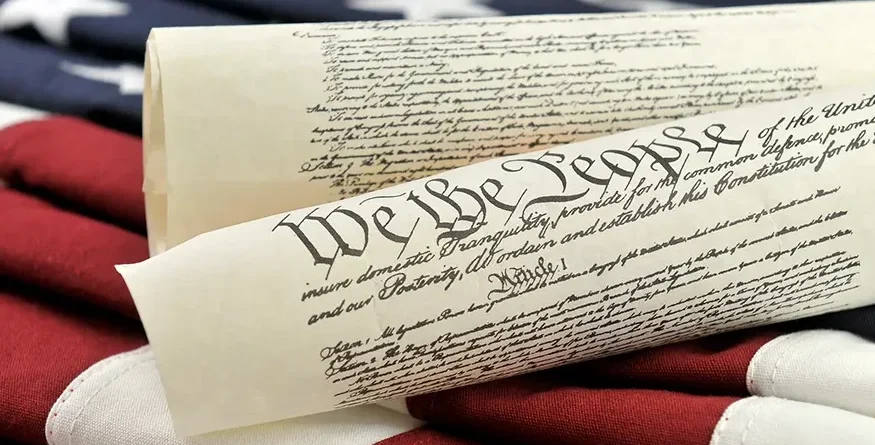
Some may not fully grasp what it means for a government to be founded “under the law.” It means that in a true democracy, even those in the highest positions of power are accountable to the law. This is the cornerstone of our republic: no one—not a president, not a judge, not a legislator—is above it. The government itself is limited by it. That principle is what makes the judiciary an essential pillar in the system of checks and balances we learned about as early as fifth grade.
The U.S. Constitution was designed with these safeguards in mind to ensure that no individual, even one acting under the guise of government authority, could rise above the law. Every year on May 1, we honor this foundational concept by celebrating Law Day, a moment to reaffirm our commitment to the rule of law and the legal system that undergirds American democracy.
On May 1, 2025, I stood with a group of fellow attorneys on Boston Common. Together, we retook our oaths—a symbolic but deeply meaningful gesture to renew our commitment to upholding the law. This act of solidarity reminded me of the profound responsibility we share as legal professionals: to defend the rule of law, especially when it feels most under threat.
In preparing for Law Day, I revisited President Trump’s first Law Day Proclamation from 2017, That proclamation reinforced key tenets of American democracy: checks and balances, separation of powers, and the rule of law. It declared:
“The Declaration of Independence thus set our Nation on its revolutionary and transformative path to protecting people’s inherent, individual rights and liberties from the tyranny of an elite few who might use the powers of the state to trample upon them.”
It went on to emphasize:
“To protect the values for which they fought, the Framers of our Constitution created a government of limited and separated powers that enables the rule of law to prevail over the whims of government officials.”
He quoted Justice Antonin Scalia, who once warned, “Every dictatorship has a bill of rights, but paper rights alone will not preserve liberty.” That proclamation concluded with a tribute to “a government of laws, and not of men”—a sentiment echoing the Gettysburg Address and its call for a government “of the people, by the people, for the people.”
In sharp contrast, the 2025 presidential proclamation took a very different tone. After more than 65 years of Law Day observance, this year’s proclamation rebranded the day as Loyalty Day. Although it acknowledged the Constitution and rule of law in passing, it lacked any affirmation of judicial independence, checks and balances, or legal accountability. Instead, it was laced with political rhetoric and an ominous appeal to patriotic obedience. It stated:
“Love of country requires loyalty to country — and a Nation without the free and impartial rule of law is not a Nation at all. Above all, we vow to usher in a new era of justice, integrity, and honor in our culture, in our courtrooms, and in our halls of Government.”
At first glance, those words may sound reasonable, even aspirational. But read more closely, and a troubling pattern emerges: the language of loyalty has replaced the language of law. The message shifts from honoring legal principles to demanding allegiance—without fully articulating to whom or what that allegiance is owed.
This subtle shift matters. Because true loyalty in a democracy is not blind faith; it is informed engagement. It is the kind of love that confronts, corrects, and holds accountable. Our legal system—imperfect but indispensable—permits criticism of government, protects dissent, and empowers reform. The rule of law is what allows discontent to coexist with patriotism. It understands that both are a form of patriotism. It is what allows us to point out our nation’s flaws and demand better from its institutions. It gives every human the right to identify our nation’s shortcomings and to work toward justice, equity, and progress.
Replacing Law Day with Loyalty Day suggests a shift in values—from accountability to obedience. Obedience is not the America our Founders envisioned. That is not the America I know and believe in.
This year, as I spoke on that platform, standing shoulder to shoulder with legal professionals recommitting ourselves to justice, my own sense of loyalty was clearer than ever. I do not love this country because it is perfect—I love it because it aspires to be better. And I remain loyal not to power or party, but to the rule of law that makes progress possible.
Justice Scalia was right: “Paper rights alone will not preserve liberty.” It takes people—courageous, vocal, and engaged people—to breathe life into those rights.
Let this Law Day, even under another name, be a call to recommit ourselves to the principles that hold our democracy together. Let it remind us that true loyalty is rooted in truth, and true patriotism is grounded in justice.